


Acon is proudly Finnish!
We're headquartered in Oulu, Finland—but we ship to Canadian customers from our U.S. warehouse for faster delivery.
Distributed by our North American Distribution Partner Distribuacon Inc.
Ships from:
6035 Queens Ave NE Ste. 200
Otsego, MN 55330, USA
Why a Proper Trampoline Bounce Matters: The Superiority of ACON Trampolines
9 Mins Read

Last updated on October 21, 2026
A proper trampoline bounce slows the body through controlled, vertical deceleration instead of producing a hard, sudden stop. A rigid frame, responsive suspension, evenly tensioned mat and secure enclosure work together to distribute landing forces over more time. This supports predictable landings, comfortable joint loading and better control for children and adults. ACON trampolines use heavy-duty steel frames and coordinated mat-and-spring engineering to create a stable rebound without the deep inward bow common in some budget models.
Understanding the Physics Behind Low-Impact Vertical Deceleration
An elastic trampoline surface reduces peak landing shock by increasing the time and distance over which the body comes to a stop.
Pavement barely moves when a runner’s foot strikes it. The body must absorb that rapid deceleration through the ankle, knee, hip and spine. A trampoline mat responds differently. It stretches downward while the springs or bungees store part of the jumper’s kinetic energy, then returns that energy during the rebound.
Depending on the equipment, testing method and landing technique, an elastic surface may absorb or redistribute up to 80% of the shock that would otherwise pass more directly into the body. That percentage is not guaranteed in every situation. The important principle is that slowing the body over a longer period generally lowers the peak impact force.
The quality of this deceleration depends on the complete system. Springs that are too stiff can create a jarring bottom point. Springs that are too soft may allow an excessively deep dip. Uneven mat tension can pull a person sideways rather than returning them along a controlled vertical path. A compatible trampoline spring set helps preserve the response intended for the frame and mat.
Controlled mechanical loading also relates to Wolff’s Law, which states that bone adapts to the loads placed on it. Appropriate, repeated loading can encourage the body to maintain stronger bone tissue. More impact is not always better, though. The benefit comes from manageable force, sound alignment and enough recovery.
This is why the idea that every trampoline provides the same health benefit is misleading. A lightweight frame may flex and bow inward under load. As the jumping surface slopes towards the centre, the feet may follow, causing the ankles to roll inward and placing extra strain on the knees. ACON’s thick-walled steel frame is designed to resist that deformation and keep the jumping surface stable.
Surface and Bounce Comparison
| Factor | Pavement Running | Budget Spring Trampoline | Premium ACON Trampoline |
|---|---|---|---|
| Surface response | Nearly rigid | Elastic but often uneven | Elastic and engineered for consistent response |
| Deceleration | Abrupt | Variable | Smooth and controlled |
| Frame behaviour | Not applicable | May flex or bow inward | Thick-walled steel resists deformation |
| Ankle and knee alignment | Depends on running form | Sloped mat may encourage inward rolling | Stable mat supports more neutral landings |
| Rebound direction | Forward and vertical | May pull the jumper toward the centre | Predictable vertical rebound |
| Peak joint impact | Relatively high | Moderate but inconsistent | Reduced through progressive deceleration |
| Best use | Running and sport-specific conditioning | Occasional recreation | Controlled exercise and family recreation |
Rebounding Benefits: How G-Force Supports Lymphatic Drainage
Repeated muscle contraction during vertical bouncing helps move lymphatic fluid through its one-way vessels.
The lymphatic system supports immune function and transports excess fluid and cellular by-products. Unlike the circulatory system, it does not have a heart-like primary pump. Lymph movement depends largely on skeletal muscle activity, breathing and changes in pressure around the lymph vessels.
A proper bounce creates a repeating cycle of acceleration and deceleration. The body feels relatively light near the top of the bounce and experiences greater loading as the mat reaches its lowest point. Leg and core muscles contract throughout this cycle, supporting the movement of lymph.
Rebounding is sometimes described as “detoxifying,” but that term can be misleading. Exercise does not replace the liver, kidneys or other organs responsible for processing and eliminating waste. Its more realistic benefit is that movement supports normal circulation and lymphatic flow.
A high jump is not required. During a gentle health bounce, the feet can remain in contact with the mat while the heels rise and fall. This makes rebounding accessible to people who want rhythmic movement without a hard foot strike. Explore equipment for trampoline exercise, including compact rebounders intended for home fitness.

Boosting Bone Density and Protecting Joints Over Time
Regular weight-bearing activity can stimulate bone remodelling, while a responsive trampoline surface reduces the abrupt peak forces associated with running on pavement.
Wolff’s Law explains that bone adapts to mechanical demands. Repeated, manageable loading signals osteoblasts, the cells involved in forming new bone tissue, to support bone maintenance and development. Each controlled landing on a trampoline provides a small loading stimulus before the mat returns energy into the next rebound.
Intensity matters. Gentle rebounding supplies less skeletal loading than high bouncing, while advanced movements require more strength and landing control. People with osteoporosis, recent fractures, joint instability, balance disorders or other health concerns should consult a qualified health-care professional before beginning.
Running remains an effective cardiovascular and weight-bearing exercise. The difference is in how the body receives the impact. Pavement stops the foot quickly, while a trampoline mat extends the deceleration phase. This may reduce peak joint stress when the user maintains proper alignment and stays within their skill level.
Calorie burn depends on body weight, exercise intensity, technique and workout duration. The ranges below are estimates rather than guaranteed results.
| Metric | Running on Pavement | Rebounding |
|---|---|---|
| Typical impact pattern | Repeated hard foot strikes | Progressive mat-assisted deceleration |
| Primary muscles | Quadriceps, calves, hamstrings, glutes | Calves, quadriceps, hamstrings, glutes, deep core |
| Stabilizing demand | Moderate | High due to the moving surface |
| Approximate calorie burn per hour | 500 to 900+ | 300 to 700+ |
| Joint loading | Higher and more abrupt | Lower peak impact when the bounce is controlled |
| Balance requirement | Moderate | Continuous vertical and lateral correction |
| Workout progression | Speed, incline, and distance | Bounce height, tempo, movement pattern, and duration |
A soft surface does not remove every risk. Beginners should keep their bounces low, place their feet about hip-width apart and track the knees in line with the toes. Stopping before fatigue affects alignment is also important.
The Neurological Edge: Enhancing Proprioception and Vestibular Balance
Every bounce requires the nervous system to interpret changes in position, speed and pressure, then make rapid corrections to keep the body upright.
Proprioceptors in the joints, muscles and tendons tell the brain where the body is in space. The vestibular system, located in the inner ear, detects head movement and acceleration. Both systems stay active during rebounding because the surface changes beneath the feet.
As the mat moves, the ankles, knees, hips and core make constant micro-adjustments. The eyes contribute by maintaining a stable visual reference. Repeating this process can support motor planning, coordination, body awareness and dynamic balance.
Children can practise age-appropriate movement patterns while learning to control their centre of gravity. Adults can incorporate gentle jogging, alternating knee lifts and side-to-side weight shifts into a fitness routine. None of these exercises requires a high bounce.
Predictability is critical. The best trampolines for proper bounce and safety return the user along a consistent path instead of pulling sharply towards the centre. A stable rebound makes it easier for the brain to anticipate movement and develop an efficient response. A stabilization handle may offer additional support for beginners or people who need more confidence, although it does not eliminate the risk of falling.

Sensory Regulation and Stress Relief Across All Age Groups
Predictable rhythmic movement may help some people regulate sensory input, release physical restlessness and feel calmer after activity.
Bouncing produces repetitive vestibular and proprioceptive input. Some people with ADHD or autism find this kind of structured movement organizing, particularly when the pace and duration are under their control. Individual responses differ. A motion that feels calming to one person may be overstimulating or uncomfortable to another.
Exercise is also associated with endorphin release and changes in neurotransmitters involved in mood, including serotonin and dopamine. Regular activity may support healthier stress responses and lower cortisol levels over time. Rebounding is not a treatment for ADHD, autism or an anxiety disorder, but it can be an enjoyable component of a broader exercise or sensory plan.
Equipment design affects the experience. Loud squeaks, sudden changes in mat tension and unpredictable lateral movement may be distracting. A smooth, quiet rebound provides more consistent input and can make it easier to settle into a comfortable rhythm. Learn more about trampolines for stress relief and the value of dependable bounce quality.
Children should be supervised throughout a session. Begin with short periods, allow only one person on the trampoline and stop if the user becomes dizzy, distressed or disoriented. An occupational therapist can provide individualized advice when rebounding is being considered as part of a formal sensory plan.
Eliminating Impact Trauma: The Zero-Gap Safety Enclosure System
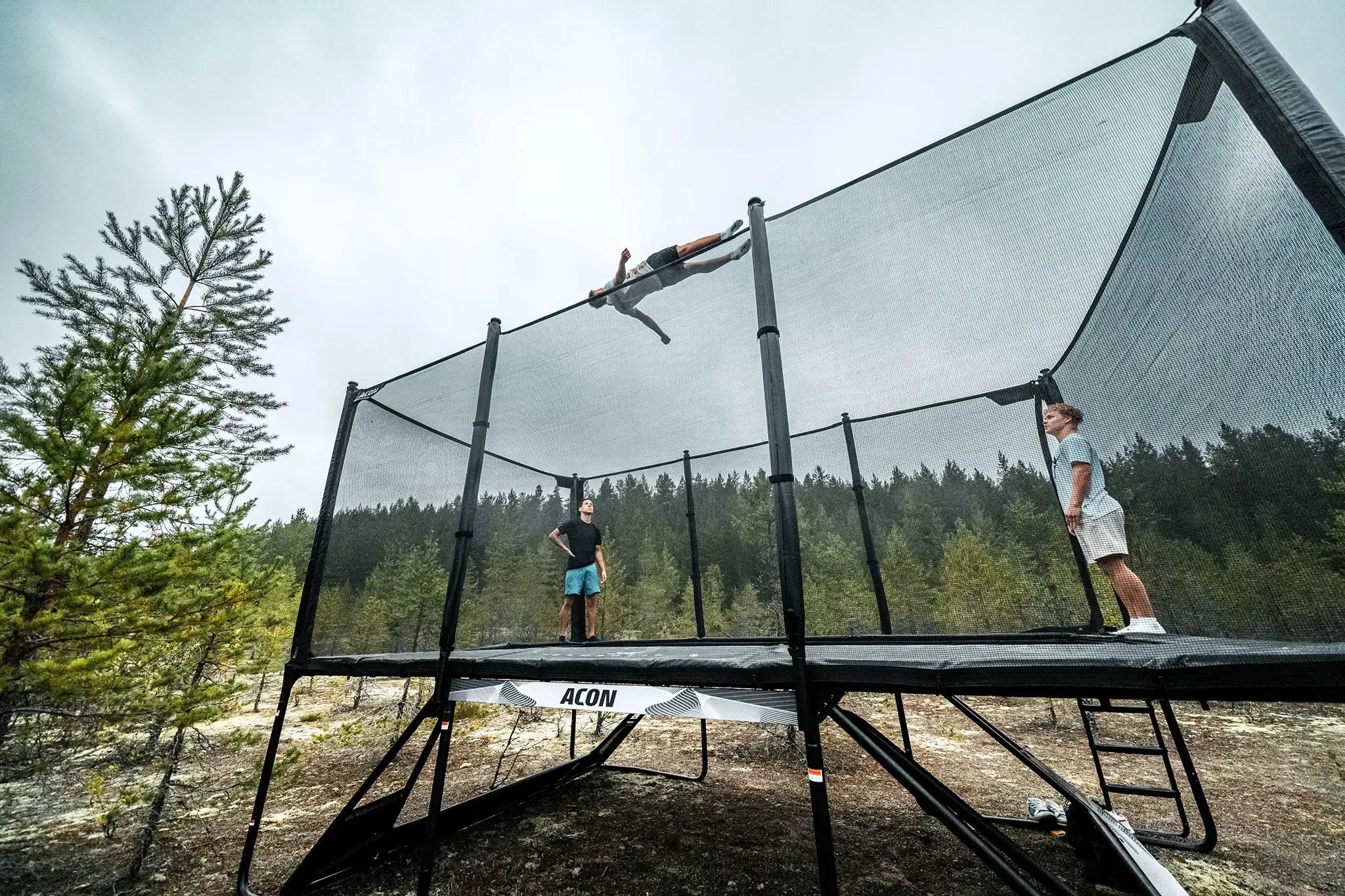
A zero-gap enclosure helps prevent falls and limits access to the frame, springs and other hard components surrounding the jumping mat.
An enclosure is an essential part of trampoline engineering, not an optional accessory. Common recreational injuries involve falling from the mat, landing on the frame or springs, colliding with another jumper, or attempting a skill beyond the user’s ability.
Some traditional enclosure systems leave an opening between the mat and the net. A foot or leg may enter that gap during an off-centre landing. A zero-gap system connects the enclosure at the boundary of the usable jumping area, creating a continuous barrier between the user and the suspension components.
Net tension matters as well. A net that is too loose may allow contact with the frame or ground before redirecting the jumper. Poorly positioned or inadequately padded poles can create additional impact points. Durable netting, secure attachment points, covered poles and an entrance that closes reliably should all be considered together.
Even the best enclosure cannot make unsafe behaviour risk-free. Basic precautions include:
- Allow only one jumper at a time.
- Supervise children during every session.
- Keep tricks within the jumper’s training and ability.
- Inspect the mat, springs, net, padding and frame regularly.
- Close the enclosure before jumping.
- Place the trampoline on level ground with suitable clearance.
- Anchor the trampoline according to the manufacturer’s instructions.
- Keep it away from trees, fences, structures, furniture and overhead hazards.
- Follow all age, user-weight and weather restrictions.
- Replace damaged parts with compatible components before resuming use.
When comparing local trampoline stores specializing in proper-bounce trampolines, shoppers should evaluate the complete safety system. Ask about frame rigidity, padding coverage, enclosure attachment, anchoring, installation support, warranties and replacement-part availability—not only maximum jump height.
The Engineering Behind the ACON Bounce: FAQ
How does the structural rigidity of an ACON frame help prevent dangerous ankle pronation?
A rigid frame helps keep the perimeter of the jumping mat level, reducing the inward slope that can contribute to unstable foot and leg alignment.
When a lightweight frame flexes towards the centre, the mat’s geometry changes. A jumper who lands on the resulting incline may be more likely to roll the ankles inward. That movement can also encourage the knees to track inward, particularly if the jumper lacks strength or landing control.
ACON’s heavy-duty steel frame is designed to resist deformation during normal use. This provides a stable foundation for the suspension system and supports a more predictable vertical rebound. Frame rigidity cannot correct improper technique or prevent every injury, but it helps remove one source of landing instability.
Why might a silent bungee or piano-wire suspension system be preferred for indoor and apartment rebounding?
Quiet suspension minimizes repetitive mechanical noise, while progressive resistance supports controlled, low-height exercise in shared indoor spaces.
Bungee systems are generally quiet because they do not use metal coils that can rub or squeak at attachment points. They often provide a soft, gradual rebound. High-quality piano-wire springs can produce a more energetic response while remaining relatively quiet when they are correctly designed, installed and maintained.
Neither option is universally better. The right system depends on the user’s preferred bounce characteristics, body weight, intended workouts and sensitivity to noise.
Apartment and indoor users should also consider:
- Available floor space and ceiling clearance
- Vibration transfer through the floor
- The stability and levelness of the surface
- Building or tenancy rules
- A protective mat beneath the rebounder
- Nearby furniture, lights and other hazards
Browse ACON Rebounders for compact equipment designed for home exercise.
Can the ACON stabilization T-bar handle assist with post-injury orthopaedic rehabilitation?
A stabilization T-bar can provide a handhold during gentle movement, but rehabilitation use should be approved and supervised by a qualified health-care professional.
A handle may help a user maintain an upright posture while practising a health bounce, weight shift, march or controlled step. It does not eliminate loading through the ankles, knees, hips or spine, nor does it guarantee protection from a fall.
Anyone recovering from surgery, a fracture, a ligament injury, vertigo or another medical condition should obtain individualized advice before using a rebounder. The T-bar is a balance aid, not a medical device or a substitute for professional rehabilitation.
What features contribute to a proper trampoline bounce?
Frame rigidity, mat tension, suspension response, spring geometry, user capacity and assembly quality work together to determine bounce performance.
The trampoline should function as a coordinated system. Strong springs attached to an unstable frame will not create the same controlled rebound as springs, mat and frame components engineered to respond together. Similarly, a rigid frame cannot compensate for a worn mat or uneven suspension.
Important trampoline features that affect bounce for children and adults include:
- A thick-walled steel frame that remains stable under load
- Springs or bungees with progressive, consistent resistance
- A durable mat with even tension
- Suspension geometry that directs energy vertically
- A user-weight range suitable for the intended jumpers
- Complete frame padding and a zero-gap enclosure
- Correct installation on firm, level ground
- Compatible replacement parts and dependable warranty support
Are proper-bounce trampolines suitable for safer landings by children?
A controlled bounce can improve landing predictability, but children’s safety still depends on supervision, proper installation, age-appropriate activity and one jumper at a time.
Children vary considerably in body weight, coordination and judgment. A suitable trampoline should respond effectively at lower loads rather than requiring a forceful landing to activate the suspension. An evenly tensioned mat and rigid frame help produce a stable return, while a secure enclosure provides protection during an off-centre landing.
No trampoline eliminates injury risk. Parents and caregivers should enforce the manufacturer’s rules, inspect the equipment before use and discourage flips, collisions, rough play and unsupervised high bouncing.
How can shoppers identify the best bounce before buying?
A quality trampoline should slow the body progressively, return the jumper along a predictable path and remain structurally stable throughout the jumping area.
If a test bounce is available, try gentle movement first and gradually increase the height within your ability. The mat should not produce a sudden stop at the bottom or pull the feet sharply towards the centre.
Shoppers should also:
- Watch the frame for visible flexing or movement.
- Check whether rebound quality remains consistent away from the centre.
- Listen for excessive squeaking or rattling.
- Review the recommended user-weight range.
- Inspect the enclosure, padding and entrance.
- Confirm warranty coverage and replacement-part availability.
- Ask whether professional installation or assembly support is offered.
The best bounce comes from the performance of the entire system, not simply an oversized spring, a very soft mat or a high weight rating.
How often should a trampoline be inspected?
Users should perform a quick visual check before every session and conduct a more thorough inspection regularly, as well as after severe weather or unusually heavy use.
Look for tears, stretched stitching, corrosion, bent components, missing fasteners, damaged springs, deteriorated padding and loose enclosure connections. Ensure that the trampoline remains level and securely anchored. Outdoor parts can deteriorate because of sunlight, moisture, temperature changes and wind even when the trampoline is not being used.
Stop using the equipment if damage could affect its structure, bounce or enclosure performance. Replace worn components with parts approved for the specific model.
Conclusion: Choose a Bounce Engineered for Control
A proper trampoline bounce combines progressive deceleration, structural rigidity, even mat tension and a secure enclosure that separates users from hard components.
These features affect much more than jump height. They influence joint loading, landing alignment, balance demands, sensory comfort and the user’s confidence. A budget trampoline may appear adequate during a brief test, but uneven suspension and frame movement can become more apparent as jump height, frequency of use and user weight increase.
ACON designs its frame, mat, suspension, padding and enclosure to function as an integrated system. This whole-system approach supports a smooth, predictable rebound for family recreation or low-impact exercise when the equipment is assembled, maintained and used according to its instructions.
For Canadian shoppers comparing the best trampolines for proper bounce and safety, long-term value also includes weather-resistant construction, replacement-part access, warranty support and dependable performance through changing seasons. A trampoline should not only bounce high—it should decelerate smoothly, remain stable and give users the control needed to land confidently.
Explore ACON trampolines and rebounders to find a model suited to your available space, intended users and preferred type of activity. Always follow the product’s assembly, maintenance and safety instructions, and consult a qualified health-care professional before rebounding if you have an injury, medical condition or concerns about balance.


